Taiyi Semiconductor|The diverse lives of the chip industry under the tariff policies of China and the United States

Quick overview of key content:
1. Interpretation of the Rules for Determining Origin
2. The impact on enterprises
3. futureprospect
A Brief History of Tariffs:
Phase One:”The Initial Experience of Taxation
In August 2017, the United States launched a "301 investigation" into China, baselessly accusing China of problems in intellectual property protection and technology transfer, laying the groundwork for subsequent tax increasesforeshadowing.
On July 6, 2018, the United States took the lead in provoking an incident by imposing a 25% tariff on Chinese goods worth $34 billion. The Chinese side immediately imposed corresponding tariffs on American agricultural products, automobiles, and other goods, marking the beginning of the bilateral tariff war between China and the United States.
On September 24, 2018, the United States imposed a 10% tariff on $200 billion worth of Chinese goods, and further increased the tariff rate to 25% in May 2019. China has imposed tariffs ranging from 5% to 25% on $60 billion worth of US goods, intensifying trade frictions between the two sides.
On August 15, 2019, the United States announced a 10% tariff on the remaining $300 billion worth of Chinese goods.China has imposed tariffs on $75 billion worth of US goods, leading to a comprehensive escalation of the US China trade war.
Phase 2:”Further slowing down of taxes
2021: After the Biden administration took office, some consumer goods tariffs were exempted from the 25% tariff policy on China during the Trump era.
In 2023, China actively defends its own rights through WTO litigation and imposes sanctions on American companies such as Lockheed Martin.
Phase Three:”The right to choose taxes
On May 14, 2024, the United States imposed 25% -30% tariffs on Chinese goods related to electric vehicles, lithium batteries, photovoltaic cells, semiconductors, and other fields. China implements export controls on key strategic resources such as rare earths.
Phase Four:”The Final Battle of Taxation
On February 1, 2025, Trump imposed a 10% tariff on Chinese goods imported to the United States, citing issues such as fentanyl.
On February 4, 2025, China will impose a 15% tariff on coal and liquefied natural gas, and a 10% tariff on crude oil, agricultural machinery, large displacement vehicles, and pickup trucks.
On March 3, 2025, the US government announced an additional 10% tariff on all Chinese goods imported to the US, citing fentanyl as the reason.
On March 10, 2025, China took reciprocal countermeasures and announced a 15% tariff on corn, chicken, wheat, and cotton originating from the United States, and a 10% tariff on agricultural products such as soybeans, sorghum, pork, beef, seafood, fruits, vegetables, and dairy products.
On April 2, 2025, Trump announced the "Global Equal Tariffs" policy, setting a "minimum benchmark tariff" of 10% for all trading partners (effective April 5), while imposing higher tariffs on 60 countries with trade deficits, including China, resulting in an increase in the total tax rate on Chinese goods imported to the United States to 34% (combined with previous taxes, some goods have a total tax rate exceeding 50%), which took effect on April 9.
On April 4, 2025, China announced the imposition of a 34% tariff on all imported goods originating from the United States, effective from April 10.
April 7, 2025: Trump demands that China withdraw its tariff measures by April 8, otherwise the United States will impose an additional 50% tariff on Chinese goods on April 9 (with a total tax rate of 104%). China's strong response will be 'resolute countermeasures'.
On April 8, 2025, in the early hours of Eastern Time, the White House suddenly announced a 50% to 84% increase in the "Section 301" tariffs on Chinese goods imported to the United States from 34%, attempting to undermine the development of China's emerging industries.
On April 9, 2025, the United States officially implemented a 104% tariff on China (including the original tax rate plus new additions), with a focus on cracking down on high value-added industries such as electronics and new energy, causing a huge impact on China's related industry exports. China has simultaneously announced a 34% tariff on all imported goods from the United States and implemented rare earth export controls (involving 7 categories of medium and heavy rare earths such as samarium and gadolinium). China has also included 16 American companies in its export control list and 11 in its "unreliable entity list". Trump has issued a revised executive order, raising the tariff rate on China to 125% and restoring the equivalent tariff rate on other specific countries to 10% starting from 00:01 local time on April 10th.
On April 10, 2025, China announced that starting from 12:01 pm on April 10, it would impose an additional 84% tariff on all imported goods originating from the United States, in addition to the current applicable tariff rate, to counter the unilateral action of the United States to raise tariffs to 84%.
As of April 10, 2025, the tariff rates of China and the United States have reached extremely high levels of 84% and 125% respectively, and bilateral trade has almost come to a halt. The trade war has entered an unprecedented stage of intense confrontation.
New rules for determining origininterpretation
China's countermeasures and updates to the rules for determining the origin of semiconductors have had a significant impact on the semiconductor industry, especially for overseas companies such as TI (Texas Instruments) ADI、 Intel Qorvo、Skyworks、 Ansenmei Microchip、Wolfspeed、 NXP, Bosch Littelfuse、 Micron, Broadcom, etc.
Some of the wafer manufacturing processes of these manufacturers' products are completed within the United States, and according to the new rules of origin recognition by Chinese customs, exports to China may face tariff pressure.
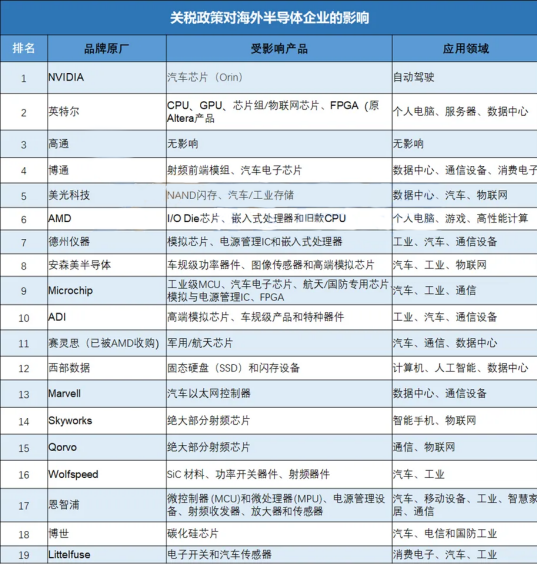
Taking TI as an example, the company produces billions of analog and embedded processor semiconductors annually, with a total of 15 manufacturing bases, including multiple wafer manufacturing, packaging and testing engineering, as well as bump and probe factories. TI's wafer manufacturing plants are mainly concentrated in the United States, with the majority of analog chips, power management ICs, and embedded processors manufactured in the United States.
That is to say, the PC industry is more affected this time. Under this new change, domestic semiconductor manufacturers benefit from huge price advantages. In the environment of greater uncertainty, the localization of analog, RF, power semiconductor, processor, optical chip, automotive grade chip and other fields is expected to usher in a golden window period.
The impact on enterprises
Against the backdrop of the escalating and uncertain trade conflict between China and the United States, Chinese companies should actively respond to national policies, closely follow national strategic guidance, quickly formulate response strategies, and adjust their corporate development strategies. The following outlines potential risks and proposes response suggestions for different roles such as terminal enterprises, upstream chip manufacturers, wafer manufacturing companies, and distribution agents:
1、 Terminal enterprise
Terminal enterprises need to build a comprehensive response system by combining production and sales with procurement
·Production and sales end
·Global Capacity LayoutBy transferring production bases to countries or regions with lower tariffs, or adopting the "China N" model, complementary production bases can be established in regions with tariff advantages to achieve flexible capacity allocation and effectively avoid tariff barriers.
·Market and customer diversificationOptimize customer structure and supply chain layout, actively explore emerging markets such as Southeast Asia and Europe, strengthen international cooperation, reduce dependence on the US single market, and diversify trade risks through cross-border cooperation and domestic and foreign trade integration.
·Tariff optimization strategyConduct in-depth research on product classification rules, adjust product classification reasonably, actively apply for tariff exemptions in conjunction with US importers, and reduce tariff cost expenditures.
·Enhance core competitivenessEnhance market competitiveness by improving product quality and brand value, and use global production capacity layout and offshore pricing strategies to reduce the impact of tariffs; At the same time, we will strengthen our awareness of intellectual property protection, strictly comply with cross-border compliance requirements, and pay special attention to export control regulations for sensitive technology equipment.
·Procurement side
·Strengthen collaboration with the original factoryMaintain close communication with chip manufacturers, comprehensively sort out affected chip models, promote the transfer of wafer production capacity or production plans to non-U.S. regions, and jointly address tariff challenges.
·Diversified procurement cooperationDeepen cooperation with international chip suppliers, especially establish cooperative relationships with suppliers from countries not involved in trade conflicts, and reduce dependence on American chips; Actively explore opportunities for cooperation with chip companies in Europe, Japan, and other regions.
·Promote domestic substitution and supply chain adjustmentAccelerate the domestic substitution process in the mid to low end chip field, such as promoting the localization of analog chips; Optimize supply chain layout, select suppliers from non conflict countries, and avoid US tariff restrictions.
·Prudent procurement of American chipsIn the face of US chip export restrictions and high tariffs, carefully evaluate procurement risks, prioritize domestic alternatives, and reduce potential supply chain risks.
2、 IDM vendors (companies with wafer fabs)
For American IDM manufacturers facing pressure from China's 125% tariff increase, they need to accelerate the pace of transferring production capacity to countries and regions outside the United States. Some companies have taken the lead in layout, such as Ruyifa Semiconductor and Infineon, implementing the "in China, for China" strategy and actively cooperating with Chinese wafer foundries; NXP has established a 12 inch wafer fab VSMC in Singapore through a joint venture with World Advanced Technology (which started construction on December 4, 2024 and is expected to reach mass production in 2027, with a production capacity of 55000 wafers per month in 2029), and has outsourced some product production to domestic wafer foundries to achieve localization of the supply chain.
3、 Fabless manufacturer
Fabless manufacturers can choose non US wafer foundries such as TSMC, Samsung, SMIC, and Huahong for wafer fabrication production. By moving the production process out of the US, they can avoid tariff risks and ensure supply chain stability.
4、 Domestic chip manufacturers
As the price of US made chips rises due to tax increases, domestic chip manufacturers should seize the opportunity, accelerate the capture of domestic market share, and actively explore global non US markets to enhance international competitiveness.
5、 Wafer foundry
Wafer foundries can moderately expand their production capacity according to market demand to undertake more orders from foreign semiconductor companies transferred due to trade conflicts and seize market development opportunities.
6、 Distribution agent
Distribution agents need to strengthen their response capabilities from multiple dimensions:
·Localization of supply chain and domestic substitutionPriority should be given to establishing cooperative relationships with domestic manufacturers, strengthening the construction of localized supply chains, and promoting the substitution of domestic chips; Evaluate non US origin sources and enrich product supply channels.
·Seize the opportunity to transfer ordersBe prepared in advance to handle the transfer of orders from American agents due to trade conflicts.
·Optimize operational strategyAccurately predict market demand and flexibly adjust procurement and pricing strategies; Strengthen compliance management and risk prevention and control system to ensure the stable operation of enterprises.
Impact Outlook
In the current situation of tariff confrontation between China and the United States, the tariff rates of both sides have risen to over 100%, and there is no sign of negotiation in the short term, which means that high tariff policies may continue in the long term. As a result, the bilateral trade volume between China and the United States has sharply declined, with semiconductor companies in the United States owning fabs (wafer manufacturing plants) bearing the brunt. To avoid the impact of high tariffs, these companies have had to re plan their production capacity layout and shift their wafer manufacturing processes to non US regions.
At present, some international manufacturers have actively cooperated with domestic wafer foundries in China. Taking Huahong Group as an example, it stands out with its rich characteristic process platform, covering technology fields such as eFlash, BCD, Power, NOR Flash, RFSOI, SiGe, etc., and has a complete vehicle specification process platform. With its technological advantages, Huahong has successfully attracted cooperation intentions from companies such as MPS, STMicroelectronics, and Infineon; Meanwhile, ADI、Microchip、Onsemi、 Renesas and other old customers continue to maintain business relations with them in the 8-inch factory, and there is greater potential for diversified development in terms of process expansion in the future. According to the announcement released by SMIC and Huahong Semiconductor, in the fourth quarter of 2024, SMIC's capacity utilization rate reached 85.5%, while Huahong Semiconductor's was as high as 103.2%, far exceeding the international industry average. With the acceleration of the localization and localization production process of mature process chips, the capacity utilization rate of these two enterprises is expected to further improve.
This tariff confrontation has created a valuable window of import substitution for domestic semiconductor manufacturers in China. The market competition pattern has undergone significant changes due to the price increase of products from American manufacturers: Intel's CPU price hike has brought development opportunities to similar products from AMD, domestic manufacturers Haiguang Information, and Loongson Zhongke; Micron's storage chip prices fluctuate, and companies such as Samsung, SK Hynix, Changxin Storage, and Changjiang Storage seize market share; TI、ADI、Microchip、 The simulation and MCU products of companies such as Ansenmei have increased in price, while domestic manufacturers such as Shengbang Shares, Sirepu, Naxinwei, and Xinhai Technology have quickly filled the market gap; The price changes of Skyworks and Qorvo's RF products have also brought growth opportunities for domestic RF chip manufacturers such as Zhuoshengwei, Weijie Chuangxin, and Huizhiwei. In addition, many American semiconductor companies have chosen to shift their orders to wafer foundries such as TSMC, UMC, SMIC, and Huahong Semiconductor in order to reduce tariff risks.
It is worth noting that the tariff confrontation between China and the United States may become the beginning of a deep rift in the economic relationship between the two countries. To cope with future uncertainty, terminal enterprises are also actively adjusting their supply chain strategies, gradually shifting their procurement channels from overseas international component distributors to domestic suppliers. Large domestic terminal enterprises have taken the lead in completing this transformation, and the trend of localizing supply chains is becoming increasingly evident.

 CN
CN EN
EN